
Get in touch
Menu


Close

Let’s work
together.
Get in touch


McCoy Contractors were appointed to undertake the full earthworks package for this major inner city regeneration scheme. This included managing all cut and fill operations across the site, stabilising the ground and preparing the formation with a high‑quality capping layer.
From the outset, the project demanded careful coordination and technical discipline, but it was McCoy’s innovative approach to material recycling that became the defining feature of the scheme.

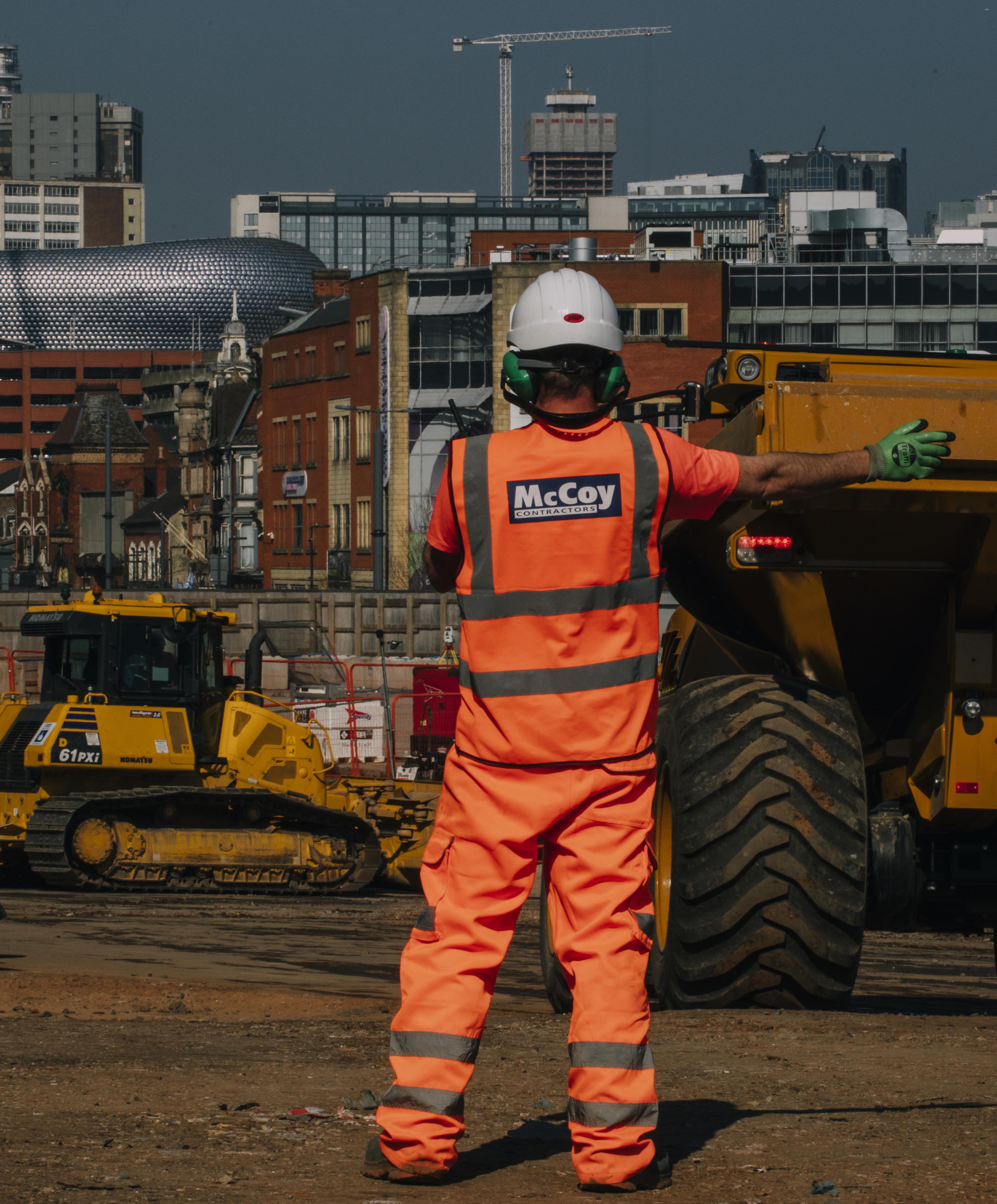
The Digbeth site carried the legacy of its industrial past, with extensive concrete yards, redundant foundations and structural slabs spread across the footprint. Traditionally, this material would have been broken out and transported offsite for disposal, with new aggregates imported to build up the formation. McCoy recognised an opportunity to rethink this process. By installing mobile crushers directly on site, the team were able to process the existing concrete into high‑quality recycled aggregate. This material was then reused throughout the earthworks, forming fill layers, sub‑base, and, where appropriate, contributing to the capping stone requirements. What would once have been treated as waste became a valuable engineering resource.
This recycling strategy delivered significant environmental and logistical benefits. By eliminating the need to export large volumes of demolition arisings and import new aggregates, McCoy dramatically reduced lorry movements in and out of Digbeth, a densely populated urban area where congestion and air quality are ongoing concerns.
The reduction in haulage not only eased local disruption but also cut the carbon footprint associated with transport and quarrying. Reusing material on site further reduced embodied carbon, aligning the project with Caddick Construction’s sustainability ambitions and demonstrating how practical innovation can reshape the environmental profile of a major development.
Alongside these sustainability gains, the approach also improved programme certainty andcost efficiency. With a consistent supply of recycled aggregate available onsite, McCoy were able to maintain momentum throughout the cut and fill operations and stabilisation works.
Once the formation wasprepared, the team placed the capping stone to create a durable, uniformplatform ready for the next phase of construction. The result was a sitedelivered to a high engineering standard, supported by a recycling strategy that maximised value and minimised environmental impact.
McCoy Contractors’ work at Digbeth stands as a strong example of how modern earthworks can combine technical expertise with responsible resource management. By treating the site’s existing materials as an opportunity rather than a burden, the team delivered a cleaner, more efficient, and more sustainable solution for Caddick Construction. It is a project that not only met the engineering brief but also demonstrated McCoy’s commitment to smarter, lower‑carbon construction practices - a model for sustainable earthworks in urban regeneration.












Have a project you'd like to discuss? Our team is ready to help.


